
GST 2.0: Navigating the 2026 Reforms for Indian Businesses
GST 2.0 is Here: Navigating the Major April 2026 Compliance Shift
As we approach the end of the 2025-26 financial year, the Indian tax landscape is bracing for its most significant overhaul since 2017. The transition to GST 2.0, combined with the Budget 2026 amendments, officially goes live on April 1, 2026.
For business owners and tax professionals, "business as usual" is no longer an option. Here is a breakdown of the trending shifts you must implement this month.
1. The Finalized GST 2.0 Rate Slabs
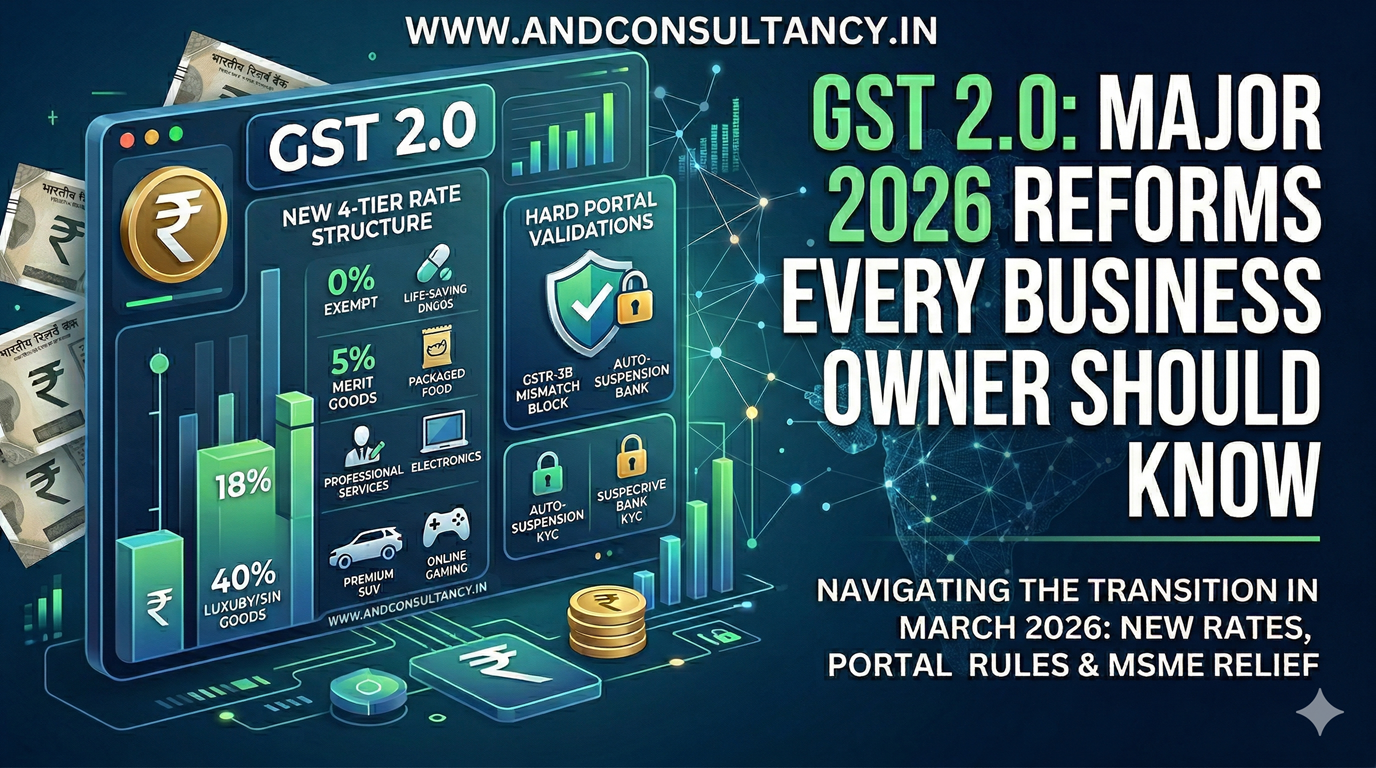
The complex multi-slab system has been officially replaced. Starting this quarter, ensure your ERP and billing software are updated to the new simplified structure:
-
5% (Merit Goods): Now includes most processed foods, apparel, and insurance (reduced from 12/18%).
Need help with this? Talk to A&D Consultancy → -
18% (Standard Rate): The primary slab for most industrial goods and services.
-
40% (Luxury/Sin Tax): A new unified slab replacing the 28% + Cess model for luxury cars, tobacco, and aerated drinks.
Need help with this? Talk to A&D Consultancy → -
0% (Exempt): Expanded list for essential education, healthcare, and life-saving drugs.
2. Budget 2026: Big Wins for MSMEs & Exporters
The Finance Bill 2026 has introduced three game-changing reliefs designed to improve your working capital:
-
Post-Sale Discounts Simplified: You no longer need a pre-existing agreement to claim GST benefits on post-sale discounts. As long as a credit note is issued and the recipient reverses the ITC, you are compliant (Amended Section 15 & 34).
-
Provisional Refunds for Inverted Duty: In a massive victory for manufacturers, 90% provisional refunds are now available for Inverted Duty Structure cases (where inputs are taxed higher than outputs).
-
Zero Threshold for Export Refunds: The minimum ₹1,000 limit for export refunds has been removed. Every rupee of your export tax is now claimable.
3. The "Hard Validation" Era of GSTR-3B
The GST portal is no longer just a reporting tool; it is an active auditor. Effective from the January-March 2026 period:
-
Automated Interest: Table 5.1 now auto-calculates interest based on your Net Tax Liability minus the Minimum Cash Balance in your Electronic Cash Ledger. This figure is now non-editable downward.
-
Auto-Suspension for Bank Details: Under Rule 10A, failing to verify your bank account details within 30 days will trigger an automatic suspension of your GSTIN, instantly blocking your e-way bill generation.
4. Intermediary Services Clarity
For firms providing services to overseas clients, Budget 2026 has finally removed the "Intermediary Service" place-of-supply anomaly. Taxation will now generally follow the location of the recipient, clearing the path for many service providers to claim zero-rated export status.
Action Plan for April 1, 2026
-
Recalculate AATO: Check if your turnover now requires mandatory registration or E-invoicing (thresholds have been tightened).
-
Audit HSN Mapping: Ensure your products moving from the old 12% or 28% slabs are correctly mapped to 5%, 18%, or 40%.
-
Update LUT: File your Letter of Undertaking (LUT) for FY 2026-27 by March 31, 2026 to continue tax-free exports.
Is your business ready for the April 1st deadline?
At A&D Consultancy, we have spent the last 12 years helping Bangalore’s businesses stay ahead of the curve. Don’t wait for a portal block to take action.
[Contact us today for a GST 2.0 Readiness ]
Have Questions? We're Here to Help
Get expert advice from A&D Consultancy. Reach out to discuss your requirements.